
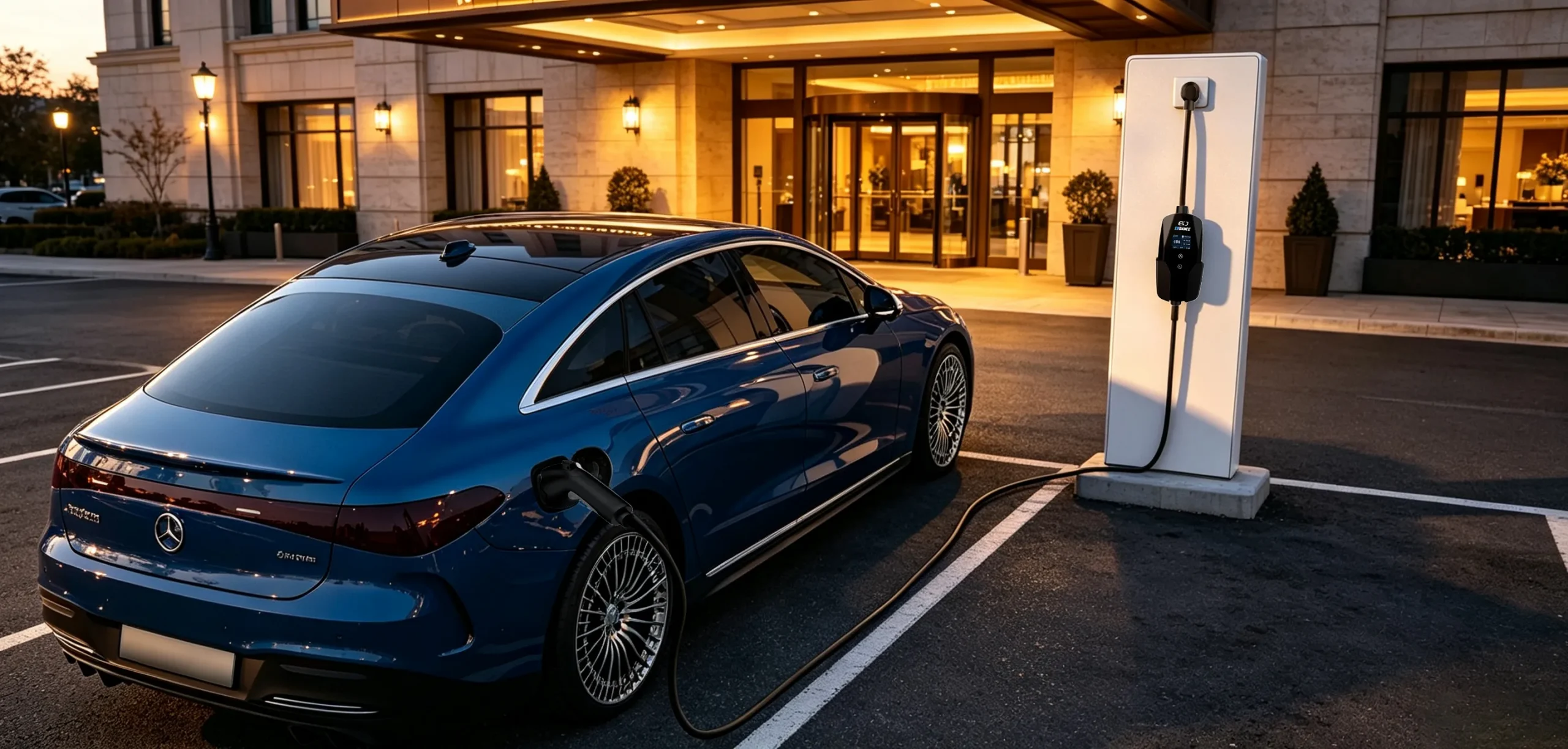
There is no universal average stay at a destination charger, because the charger does not set the clock — the visit does. Drivers stay for the length of the activity that brought them: a hotel guest stays the night, a cinema guest stays for the film, an employee stays for the shift. The car charges inside a window the venue created, which is exactly what destination charging means.
Key Takeaways
- No universal average stay exists — the venue’s activity sets the stay, and the charger fills the window.
- The session clock and the stay clock are different; at destination sites the stay is almost always longer.
- Hotels, cinemas, supermarkets and workplaces are different stay products under one label.
- Hosts match Level 2 pace to the stay, then manage sitting time with posted terms, not faster hardware.
The Stay Belongs to the Venue, Not the Charger
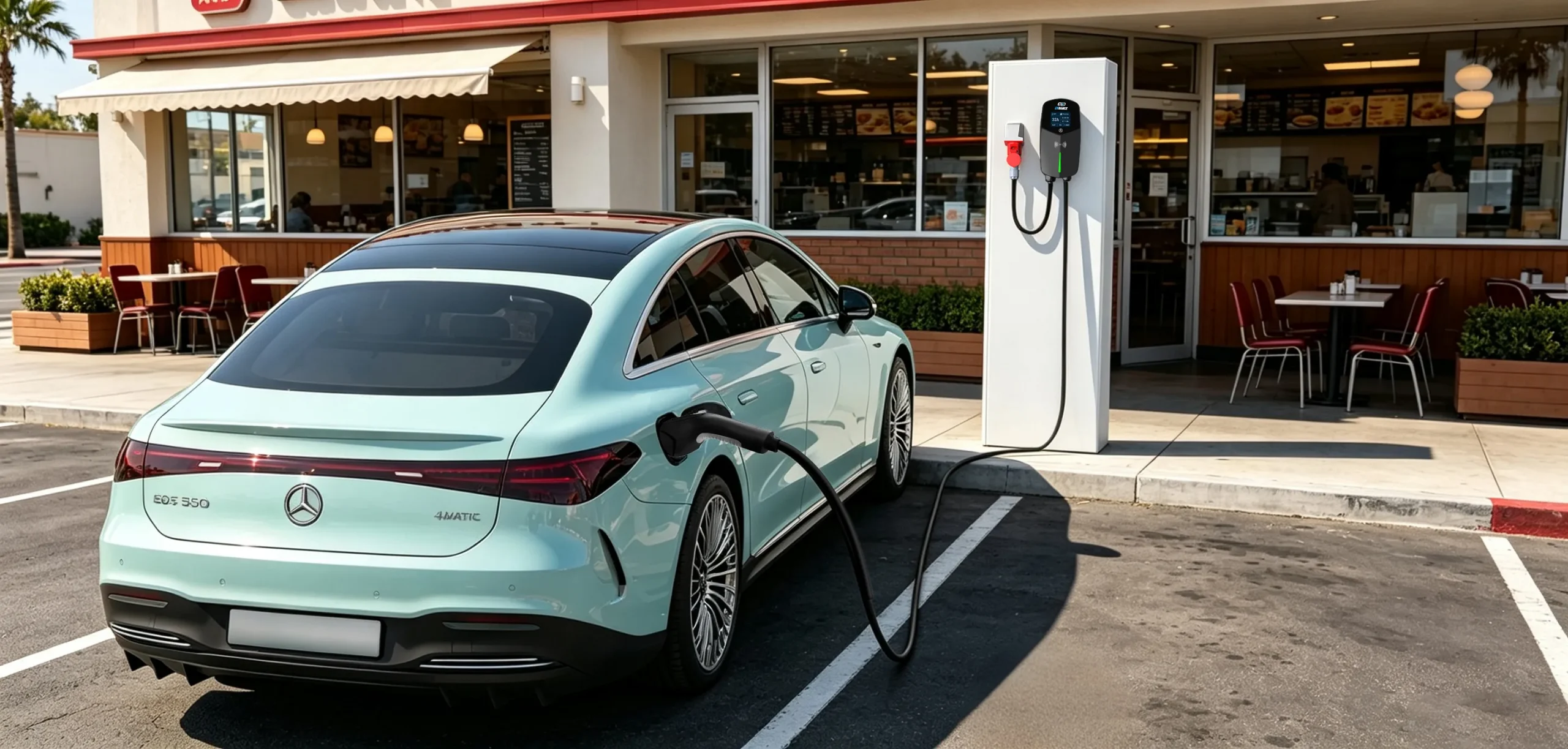
Two different clocks run at a destination bay. The session clock stops when the battery reaches the level the driver set. The stay clock stops when the driver comes back — after dinner, after the meeting, after checkout. At destination sites the stay clock is almost always the longer one, and it shapes everything else: how much energy a bay delivers in a day, how many drivers it serves, and whether one car blocks it for everyone else. As EV charging for restaurants and retail shows, the hardware is ordinary Level 2 — the setting does the defining.
Stay Length by Venue Type
| Venue | What sets the stay | What the car does meanwhile |
|---|---|---|
| Hotel | The night — arrival in the evening, departure next morning | Charges early in the stay, then sits plugged in until checkout |
| Restaurant or cinema | The meal or the film — one sitting, start to finish | Takes a top-up sized to a single visit |
| Supermarket or retail park | The shop itself — a trolley round, not an afternoon | Adds a modest top-up; the shortest destination stays of all |
| Workplace | The working day — the car arrives and leaves with the employee | Shares the day with other staff cars if bays rotate |
| Gym or leisure centre | The workout or the class timetable | Charges across one or two activity slots |
None of these are charger statistics — they are the durations of ordinary activities. That is why a single “average dwell time” would describe no real site: a hotel bay and a supermarket bay are different products wearing the same label.
Why Hosts Match the Charger to the Stay
Level 2 pace is the fit for these windows. The U.S. DOT rates Level 2 at roughly 10–20 miles of range per hour, which turns a hotel night or a working day into a full battery without fast-charging hardware. The mismatches cost money: rapid hardware at an overnight site buys speed nobody uses, while one slow bay at a short-stay site serves few drivers per day. Hosts manage the stay side with posted terms — time limits, idle fees after charging ends, bay rotation for staff — because those rules, not the charger, decide how long a car may sit.
Hardware Sized for Long-Stay Sites
Destination hardware is managed AC: access control for guests or staff and session records for the host. The EV-AC03201T dual-connector AC station — two Type 2 connectors sharing up to 43 kW (22 kW per connector), OCPP 1.6J, RFID, IP54 — serves two stays at once. For a single wall bay, the EV-ACT3204PE 22 kW wallbox (tethered Type 2 cable, RFID and app, IP66, CE) covers the same pattern at smaller scale. Hosts comparing formats start from our commercial charging page.
Frequently Asked Questions
Do drivers unplug as soon as charging finishes?
Usually not at destination sites — the driver is mid-film, mid-shift or asleep. The car often sits connected after the session ends, which is why hosts use idle fees or time limits where bays are scarce. Whether that applies is the host’s posted policy, so check the listing before you rely on a bay.
Is a longer stay better for the host?
It depends which clock you mean. A long stay suits one driver’s battery, but a bay serves more drivers across short stays. The trade-off is set by the venue’s own pattern — our guide to whether hotel EV charging is free shows how the longest-stay venue, the hotel, handles it.
How much range does a typical destination stay add?
Work it from the DOT’s Level 2 pace of roughly 10–20 miles per hour across however long your visit lasts — a meal adds a local top-up, a hotel night can refill the car outright. The classes behind those numbers are compared in Level 1 vs Level 2 vs DC fast charging.
Related Reading
- EV Charging for Restaurants and Retail: Turning Dwell Time Into Visits
- Where to Find EV Charging Stations: Maps, Apps and Tips
- Is Hotel EV Charging Free?
- Level 1 vs Level 2 vs DC Fast Charging: A Practical Comparison

