
Farms charge electric tractors and utility vehicles where the machines sleep: in the barn or the yard, on an AC charging point matched to the machine. The charger choice comes second: first come the machine’s own documents, stating its inlet and the rate it accepts, and the building’s supply — because on a farm the nearest public charger is rarely part of the plan.
Key Takeaways
- The machine’s documents come first: its inlet and acceptance decide what charging equipment can serve it.
- Charging happens on the farm, where machines sleep — distance from public chargers makes the barn the plan.
- Existing farm supplies are an asset to survey, not assume; an electrician confirms what a building can carry.
- Season sets the pattern: nightly discipline at peak, relaxed AC in normal months, maker-guided storage off-season.
Start With the Machine, Not the Charger
An electric tractor or UTV is charged through the inlet its maker fitted, at a rate its onboard equipment accepts — and both facts live in the manufacturer’s documents, not in a charger catalogue. So the order of work is fixed: read the machine’s handbook for its inlet and acceptance, then choose charging equipment that matches, then have the building’s wiring checked for that load. Buying the charger first and discovering the machine’s terms afterwards is the expensive order. Where a machine’s maker offers its own charging guidance or approved equipment, that guidance governs.
The Farm’s Existing Electrical Assets
Farms start ahead of most sites in one respect: many farm buildings already carry a serious supply, because workshops, dryers, pumps and machinery needed one first. Three-phase power is a common existing asset in agricultural buildings — but “common” is not “yours”. What a given barn has, and its spare capacity alongside everything else the building runs, is a survey question for a licensed electrician, answered from your supply documents. That survey decides whether the charging point is a simple addition or a supply project, along the same planning route as any commercial charging installation.
Season Decides the Pattern
| Season | The machines’ pattern | What charging must do |
|---|---|---|
| Peak work (planting, harvest) | Long days, short nights, machines back late | Charge every night without fail; the overnight window is the tightest of the year |
| Normal season | Regular yard and field work, full nights parked | Overnight AC covers the work comfortably |
| Off-season | Machines parked for weeks at a time | The maker’s storage guidance governs battery state; the charger’s job is availability, not daily filling |
Level 2 adds roughly 10–20 miles of range per hour on U.S. DOT figures for road vehicles; for machinery, translate that into hours parked — the dwell is the resource, and farm dwell is long. That is why farms, like other return-to-base fleets in our depot charging guide, rarely need fast charging: the exception is the peak-season day that overruns, not the routine.
Dust, Moisture and Yard Reality
- Ratings are the maker’s figures. A charger’s stated IP rating describes its enclosure against dust and water; it, and the machine maker’s guidance, governs where equipment may live.
- Connectors live off the ground. A holster or hook at the parking spot keeps the connector out of mud, standing water and the tyre path, as in any working yard.
- Inspect like other kit. Cables and connectors join the weekly walk-round; our commercial charger maintenance checklist adapts directly.
The Portable Three-Phase Shape
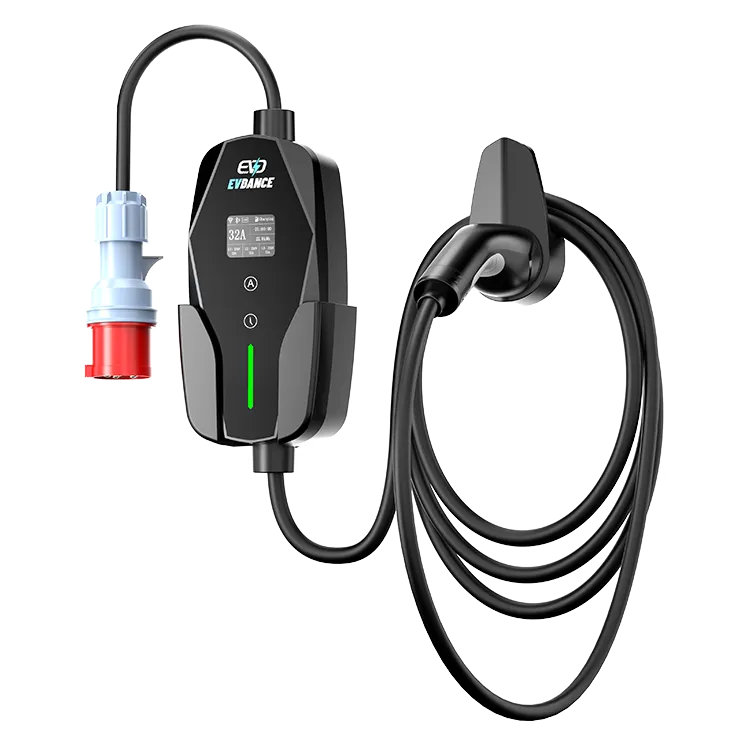
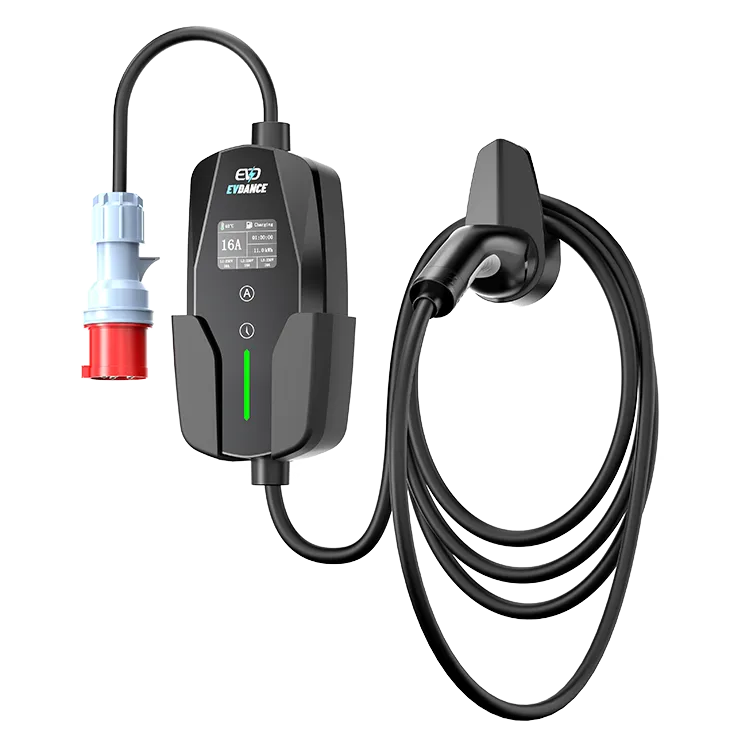
Where a farm building already has a suitable three-phase industrial socket, a portable charger uses it with no fixed installation, and moves between buildings as work moves. The EV-ACS3205PE is a 22 kW three-phase portable (32 A three-phase, CEE 32 A plug, Type 2, IP66); the ACS1605PE is its 11 kW sibling (16 A three-phase, CEE five-pin, Type 2, 7.6 m cable, IP66). Both are named only as the socket-fed shape that fits farm buildings: whether either suits a particular machine depends on its documented inlet and acceptance, which only its maker states. The full range is on the products page.
Frequently Asked Questions
Can a tractor charge from the farm’s existing sockets?
Only when two documents agree: the machine’s handbook, stating its inlet and what it accepts, and an electrician’s assessment of the socket and circuit for a continuous load. Neither answer comes from the socket’s shape alone.
Does a farm need DC fast charging for machinery?
Almost never. Machines are parked where they work for long stretches, and AC charging inside that dwell covers the duty. DC belongs to short-turnaround operations; a farm’s turnaround problem is seasonal and is usually solved by charging discipline in peak weeks.
What if the barn has no three-phase supply?
Then machine requirements and a supply upgrade become one project, scoped by an electrician and the supplier. Single-phase AC at lower rates may still serve lighter utility vehicles — the machine’s documents and the survey decide.
Related Reading
- Fleet Depot Charging: How to Size AC Chargers for Vans and Light Commercial Vehicles
- How Do Commercial EV Charging Stations Work?
- Commercial EV Charger Maintenance Checklist
- How to Plan a Workplace EV Charging Program

