
NACS names the plug, not a speed. The same connector shape covers home chargers running at Level 2 speeds of roughly 7 to 19 kW and public DC fast chargers running at 50 to 350 kW. So “how fast is a NACS charger?” has two answers: at home it charges like any Level 2 charger, and on the road it charges like any DC fast charger. The equipment behind the plug decides — never the plug itself.
Key Takeaways
- NACS is a connector, not a speed class — the charger behind the plug sets the speed.
- Home NACS chargers are Level 2: roughly 7.7 kW at 32 A, 9.6 kW at 40 A, up to about 11.5 kW at 48 A.
- Public NACS DC stations sit in the same 50 to 350 kW band as CCS1 fast chargers.
- Your car caps every session — on AC through its onboard charger, on DC through its maximum rate.
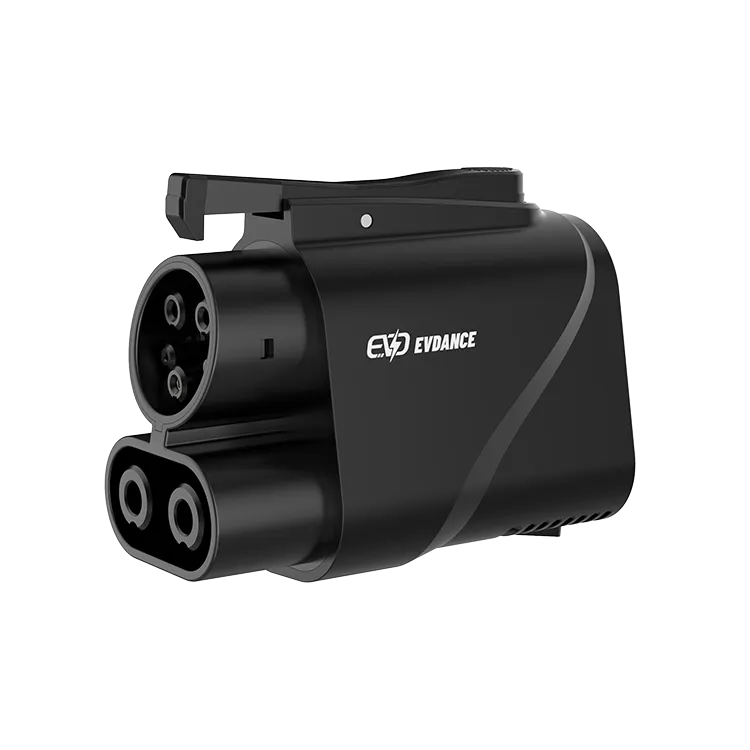
NACS at Home: Level 2 Speeds
A home NACS charger is an AC charger: it feeds alternating current to the car, and the car’s onboard charger converts it. That puts it in the U.S. Department of Transportation’s Level 2 band of 7 to 19 kW, adding roughly 10 to 20 miles of range per hour — the same band as any J1772 home charger, as our guide to how many kW a Level 2 charger is sets out. What varies is the unit’s current rating:
| Home NACS charger | Current | Power |
|---|---|---|
| Portable charger, 32 A class | 32 A | About 7.7 kW |
| Portable charger, 40 A class | 40 A | 9.6 kW |
| Wall charger, 48 A class | 48 A | Up to about 11.5 kW |
For comparison, the Tesla Wall Connector is rated up to 48 A and 11.5 kW on a 60 A breaker. Because EV charging is a continuous load under the National Electrical Code, the breaker is sized at 125% of the charger’s current: 32 A needs a 40 A breaker, 40 A a 50 A, 48 A a 60 A. Plugged into a household outlet instead, any of these falls back to Level 1 — about 1 kW, and 2 to 5 miles of range per hour.
NACS in Public: DC Fast Charging Speeds
At a public DC station, the same connector delivers direct current straight to the battery. The U.S. DOT figures put DC fast charging at 50 to 350 kW, adding about 180 to 240 miles of range per hour at the top of the band. There is no separate “NACS speed” in that band — a NACS DC station and a CCS1 station of the same rating deliver the same power, which is why our explainer on how fast a DC fast charger is applies to both. One fixed point: federally funded NEVI corridor stations must provide CCS1 on their DC ports, so a NACS cable there is an addition beside CCS1, never the only option.

What Actually Sets Your Speed
- The charger’s rating. A 7.7 kW portable unit cannot give you 11.5 kW, whatever the car can take.
- The car’s limit. On AC, the onboard charger caps the session; on DC, the car’s maximum DC rate caps it.
- The session itself. DC charging slows as the battery fills, so the headline kW is a peak, not an average.
- The connector is not on this list. NACS, J1772 and CCS1 are connection shapes and standards — see our explainer on whether the Tesla charger is NACS.
NACS Chargers From EVDANCE
For home charging, the EV-ACS3210T 32A NACS portable charger delivers about 7.7 kW from a NEMA 14-50 outlet, adjustable from 10 to 32 A in six steps. The EV-ACS4005T 40A NACS portable charger raises that to 9.6 kW, with 16/24/32/40 A settings. For a fixed installation, the EV-ACT5006T 48A Level 2 wall charger is hard-wired or plugs into a NEMA 14-50 outlet. All three charge at the Level 2 speeds in the table — the choice is current rating and installation style, not connector speed.
Frequently Asked Questions
Is a NACS charger faster than a J1772 charger?
No. At home both are Level 2 AC chargers in the same 7 to 19 kW band, and the car’s onboard charger sets the ceiling. The difference is connector shape and fit, not speed.
Why does a NACS fast charger show 250 kW but my home NACS charger only 9.6 kW?
Different equipment, one connector. The public unit converts power in the station and feeds DC to the battery; the home unit passes AC to the car’s onboard charger.
Can my car charge at the full speed of a NACS DC station?
Only up to your car’s own maximum DC rate, and only near the peak of its charging curve. The station’s headline figure is its ceiling, not a promise for every car.
Related Reading
- Is the Tesla Charger NACS? NACS, J3400 and Adapters Explained
- How Many kW Is a Level 2 Charger?
- How Fast Is a DC Fast Charger?
- Type 2 vs J1772 vs NACS: Which EV Charger Connector Does Your Market Need?

