
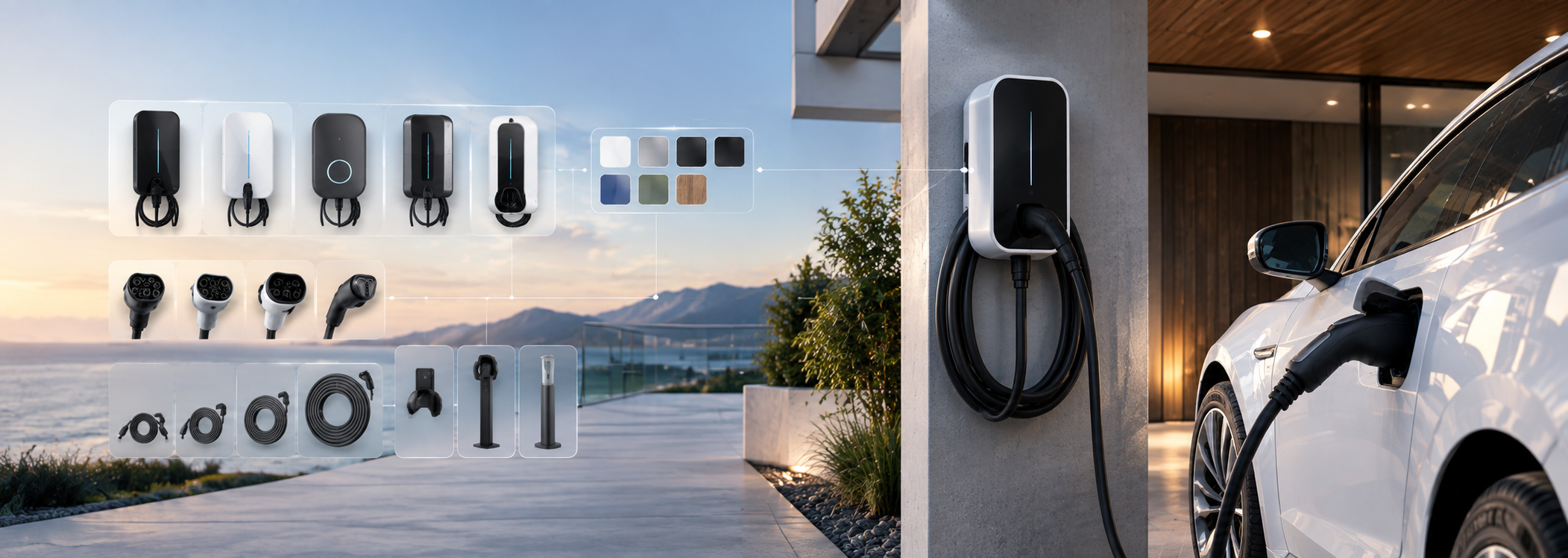
A charging pile OEM/ODM project puts a factory’s tested EV charger platform under your brand. With OEM you pick an existing model and change what your customers see: logo, colour, plug, cable and packaging. With ODM you send a brief and the factory proposes a configuration, builds samples and then moves to production. At EVDANCE, logo-print batches start at 100 units with a 2–3 week lead time, full mould customisation starts at 500 units, and samples of 1–9 units ship within days. This guide covers the decisions to make, and the order to make them in, so the quotes you collect can be compared line by line.
Key Takeaways
- “Charging pile” is the Chinese industry term for an EV charging station. Wallboxes, floor-standing stations and portables can all be supplied as OEM or ODM.
- OEM is the fastest route to market: same hardware, your brand. ODM starts from your brief and adds sample and validation rounds.
- EVDANCE order tiers: samples 1–9 units, small batch 100–499 units with custom logo print (2–3 weeks), full OEM 500+ units with mould customisation.
- Decide market, connector and supply plug first. They decide which certificates and test reports you need, and so which models are realistic.
- A complete first inquiry (product, market, plug, quantity, branding) gets a usable quote in one round.
What “Charging Pile OEM/ODM” Means
Buyers who search for charging pile OEM/ODM, electric vehicle charging station OEM/ODM or car charging station OEM/ODM are asking the same thing in different words. “Charging pile” is a direct translation of the Chinese term for a charging station, so it shows up on Chinese factory sites and in sourcing platforms. Our explainer on what an EV charging pile is covers the terminology. For sourcing, what matters is which service model you are buying.
| OEM (our product, your brand) | ODM (designed around your brief) | |
|---|---|---|
| Starting point | An existing EVDANCE model | Your target market, power level, connector and feature list |
| What changes | Logo and nameplate, colour and finish, display UI, LED accent, regional plug, connector, current settings, cable length, packaging | The configuration itself, proposed by the factory and confirmed through samples |
| Extra steps | Logo proof (3–5 days), then samples | Configuration proposal, samples for your own testing, then production |
| Best for | Distributors and brands that want to sell quickly and test demand | Brands with a defined product gap or a market-specific requirement |
The two terms are used loosely across the industry, so confirm in writing what each supplier means before comparing prices. We explain the gaps in OEM vs ODM EV chargers: what your supplier means.
Which Charging Piles Can Carry Your Brand
Every product family below can be supplied as a stock unit for wholesale or rebranded as your own. The specifications come from the EVDANCE product pages.
| Model | Type | Output | Connector / notes |
|---|---|---|---|
| EV-ACT3204E | Wallbox | 7 kW (32 A single-phase) | Wall-mounted AC unit |
| EV-ACT3204PE | Three-phase unit | 22 kW (32 A three-phase) | Type 2 (IEC 62196-2), IP66, 5 m or 7.6 m cable |
| EV-ACT4001T / U | Plug-in wallbox | Up to 9.6 kW, 6–40 A adjustable | NACS (T) or J1772 (U), NEMA 14-50 input, NEMA 4 / IP66 |
| EV-ACT5002T / U | Hardwired wallbox | Up to 12 kW, 50 A | NACS or J1772, front display, optional Wi-Fi / Bluetooth / 4G |
| EV-ACT5006T | Wall-mounted station | 11.5–12 kW, 48 A / 50 A | NACS, hardwired or NEMA 14-50P, IP65 / IP66 |
| EV-AC03201T | Floor-standing station | 43 kW combined, 22 kW per gun | Two Type 2 guns, OCPP 1.6J, IP54, 7-inch touchscreen |
Portable chargers (EV-ACS1605PE, EV-ACS1602PE, EV-ACS3210E, EV-ACS3210T, EV-ACS4005T) and adapters (JT02, JT08, JT09) can go into the same order. Portables, wallboxes and adapters can be quoted and shipped together.
Wall-Mounted Charging Pile OEM/ODM: The Usual Starting Point
Most brands start with a wallbox. It is the product installers fit most often, it carries the most visible branding surface, and it does not need civil works. The questions are practical: single-phase or three-phase, tethered cable or socket, display or no display, app or plug-and-charge. Each answer narrows the platform, and some (a display, an app) open more branding options.
We go through each customisable element, and what stays fixed, in Wall-Mounted Charging Pile OEM/ODM: What a Brand Can Customise on a Wallbox.
European Standard Charging Pile OEM/ODM: Building for the EU
“European standard” in a buyer’s brief usually means a Type 2 vehicle connector to IEC 62196-2, charging behaviour to IEC 61851, and a product that can carry the CE mark on the basis of a technical file you, as the brand owner, can stand behind. For portables, the in-cable control and protection device falls under IEC 62752. None of this is decoration. Once your brand is on the nameplate, the regulator treats you as the manufacturer, so you need access to the test reports behind the CE declaration.
Our sub-guide European Standard Charging Pile OEM/ODM: Type 2, IEC 61851 and the CE File lists the documents to request and how to check that they match the exact configuration you are buying.
Factory-Direct R&D Support: When the Brief Goes Beyond a Logo
If you need a different current range, a market-specific plug, branded firmware screens, a private-label app or OCPP connectivity for a platform you already run, you are buying engineering time as well as hardware. EVDANCE develops power electronics, embedded firmware, enclosure design and cloud software in-house, according to our Technology & R&D page. That is what makes ODM requests possible without starting from zero.
How to tell whether a supplier’s R&D support is real, and what to put in writing before samples, is covered in Where to Source Integrated EV Chargers with Factory-Direct R&D Support.
Order Tiers, Lead Times and Supply Stability
| Tier | Quantity | What you get | Timing |
|---|---|---|---|
| Sample | 1–9 units | Stock colourway, standard logo sticker | Ships within days |
| Small batch | 100–499 units | Custom logo print, choice of colourway | 2–3 week lead time |
| Full OEM | 500+ units | Full mould customisation, private packaging, dedicated account manager | Quoted with the order |
Logo proofing takes 3–5 days, with revisions before tooling. The small-batch tier lets a distributor prove a market before committing to moulds. Our guides to EV charger MOQ and tooling and moulds for charger housings explain where those thresholds come from.
Lead time is only half the delivery question. The other half is whether the second, third and tenth order arrive on time and identical to the first. How to Judge an EV Charging Station Supplier’s Supply Stability and Delivery gives a checklist for that.
Which Route Fits Your Business
The right tier depends less on budget than on how certain you are about demand and how much of the product your customers will see as “yours”.
| Buyer | Typical situation | Sensible route |
|---|---|---|
| Importer or distributor new to a market | Needs to test which power level and connector sells | Samples across two or three models, then a 100–499 unit logo-print batch of the best performer |
| Established distributor adding a house brand | Knows volumes, wants margin and differentiation | Full OEM from 500 units: own colour, mould details, private packaging |
| Brand with a defined product gap | Needs a configuration no stock model offers | ODM brief, samples for your own testing, then production |
| Installer or charge point operator buying for projects | Wants consistent hardware across sites, sometimes co-branded | Stock or small-batch units of one platform; OCPP-connected models where a back office is used |
One practical point for distributors: keep the first branded batch small enough that you can change the connector or plug mix on the second order. A 50-unit batch on a model you have already sampled is a low-risk way to collect real installer feedback before moving to moulds. Our article on how much stock an EV charger distributor should hold helps size that first order.
From Brief to Shipment: The Five Steps
| Step | What happens | What you should receive |
|---|---|---|
| 1. Brief | You send product, market, plug type, quantity and branding | Questions back on anything missing |
| 2. Specs and quote | The factory confirms configuration, price and lead time | A written specification, not only a price |
| 3. Logo proof and sample | Proof in 3–5 days, then samples for your testing | Artwork proof and the sample’s exact configuration |
| 4. Production | Bulk production after sample approval | Confirmation that production matches the approved sample |
| 5. QC and shipping | Inspection, packing and FOB or DDP shipping | Inspection record, packing list, shipping documents |
Step 3 is where most projects gain or lose time. Approve the sample in writing and keep one sealed as the reference: see golden samples: locking in the approved charger.
What to Put in Your First Inquiry
- Product family: wallbox, floor-standing station, portable or adapter, or “not sure yet”.
- Target market: the country decides voltage, phases, connector and the certificates you will be asked for.
- Supply plug and vehicle connector: for example CEE, Schuko, NEMA 14-50 or hardwired, plus Type 2, Type 1 (J1772) or NACS.
- Quantity: a first-order figure and a 12-month estimate, so the factory can propose the right tier.
- Branding: logo files, colour (Pantone if you have one), packaging language and whether you need a private-label app.
- Shipping terms: FOB or DDP. Our FOB vs DDP guide compares the two.
Common Mistakes That Slow an OEM Project
- Choosing the colour before the market. Connector and certification constraints should narrow the model list before you spend time on artwork.
- Asking for “all certificates”. Ask for the reports that cover the exact model and plug configuration you are buying. A range-wide certificate list does not prove that.
- Skipping the sample. A sample is cheap compared with a batch that does not match your market’s sockets.
- Treating firmware as fixed. If the unit has an app or OCPP, agree who owns updates. See firmware ownership in a supply contract.
Ready to brief a charging pile OEM/ODM project? Send the product, market, quantity and branding through our EV charger OEM & ODM page. We reply with a quotation, sample options and a lead time.
Frequently Asked Questions
What is the minimum order for an OEM charging pile?
Custom orders start from 100 units with logo print and a choice of colourway. Full mould customisation and private packaging start from 500 units. Samples of 1–9 units are available first.
Is ODM slower than OEM?
Usually, yes. ODM adds a configuration proposal and sample validation before production. OEM on an existing model skips those steps, which is why it is the faster route to market.
Can wallboxes, stations and portables be in one order?
Yes. Portables, wallboxes and adapters can be quoted and shipped together.
Who is the legal manufacturer when my brand is on the charger?
In the EU and UK, whoever places the product on the market under their own name takes on the manufacturer’s obligations. Make sure you can access the technical file and test reports. Brand compliance files lists what to keep.
Related Reading
- Wall-Mounted Charging Pile OEM/ODM: What a Brand Can Customise on a Wallbox
- European Standard Charging Pile OEM/ODM: Type 2, IEC 61851 and the CE File
- Where to Source Integrated EV Chargers with Factory-Direct R&D Support
- How to Judge an EV Charging Station Supplier’s Supply Stability and Delivery
- Customized EV Charger Manufacturer: What Can Actually Be Customised

