
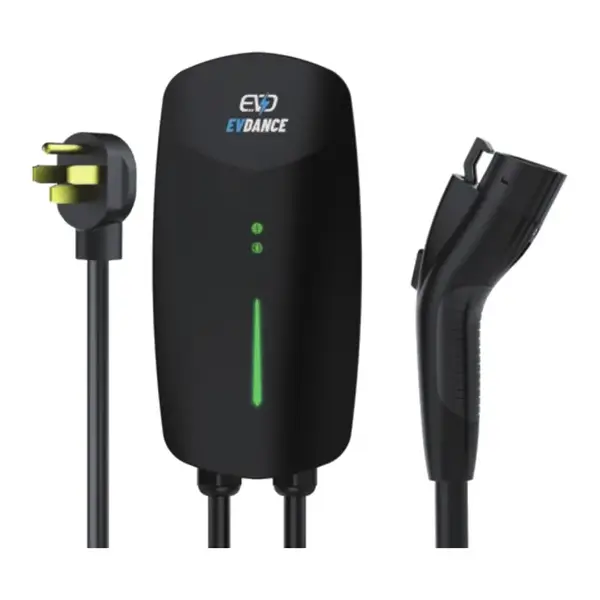
A Level 2 home charger is a wall-mounted 240 V charger that refills most EVs overnight — typically 7.7 kW at 32 A, 9.6 kW at 40 A or 11.5 kW at 48 A. For most drivers it is the single biggest upgrade over the Level 1 cord that comes with the car. This guide covers which size to choose, plug-in versus hardwired, the features worth paying for, and what installers and resellers should keep in mind when supplying home chargers.
Key Takeaways
- Choose the charger size by your car and your panel, not by the biggest number on the box.
- A 40 A plug-in unit on a NEMA 14-50 outlet covers most homes; 48 A needs a hardwired 60 A circuit.
- Useful features: adjustable current, scheduling for off-peak tariffs, outdoor rating, a 25 ft cable.
- Check your connector: NACS or J1772, depending on the car.
- Installation by a licensed electrician, with a permit where required.
What a Level 2 Home Charger Does
The charger supplies 240 V AC to the car and tells it how much current it may draw; the car’s onboard charger converts it to DC for the battery. For background, read what is a Level 2 home charger and the full Level 2 EV charger guide.
Which Size Level 2 Home Charger Do You Need?
| Charger | Power at 240 V | Range added per hour (approx.) | Circuit | Good fit when |
|---|---|---|---|---|
| 32 A | 7.7 kW | about 25–30 miles | 40 A | Average daily driving; panel is tight |
| 40 A | 9.6 kW | about 30–37 miles | 50 A | Most homes; NEMA 14-50 outlet |
| 48 A | 11.5 kW | about 35–45 miles | 60 A | Car accepts 11 kW+; two EVs; long commutes |
Range figures vary with the car’s efficiency. If the car’s onboard charger accepts 7.2 kW, a 48 A unit will not charge it faster than a 32 A unit. For the maths, see how many kW a Level 2 charger delivers, and for the decision itself, which Level 2 charger should I buy.
Plug-In or Hardwired at Home
Plug-in units are easy to replace and take with you when you move; they top out at 40 A on a NEMA 14-50 outlet. Hardwired units can deliver 48 A or more and avoid outlet wear. The installation guide covers both.
Features Worth Paying For
- Adjustable current — essential if the panel has limited capacity.
- Scheduling — charge on off-peak electricity rates, via app or on the unit.
- Outdoor rating — NEMA 4 or IP65/IP66 for driveways.
- Cable length and holster — 25 ft and a cable hook keep the cable off the ground.
- Load management — for homes with two chargers or limited service; see dynamic load balancing.
More on this in what features matter most in a home EV charger, what is a smart home charger and what makes a home EV charger reliable.
Is a Level 2 Home Charger Worth It?
For most daily drivers, yes: Level 1 adds only about 3–5 miles per hour, which can fall short after a long day. See is a Level 2 charger worth it for the trade-offs.
For Installers and Resellers
Home chargers are often sold through electricians, solar installers and EV dealers. A practical range is one plug-in 40 A model and one hardwired 48–50 A model, each in NACS and J1772. Ask suppliers for manuals in your language, the test reports for your market, spare parts, and how warranty replacement works. EVDANCE home Level 2 chargers can be supplied as stock units or under your own brand:
| Model | Current | Connection | Connector |
|---|---|---|---|
| EV-ACT4001T / U | 6–40 A adjustable | NEMA 14-50 plug | NACS / J1772 |
| EV-ACT5002T / U | Up to 50 A | Hardwired | NACS / J1772 |
| EV-ACT5006T | 48 A / 50 A max | Hardwired or NEMA 14-50P | NACS |
See OEM & ODM for private label, or the manufacturer and supplier guide.
Frequently Asked Questions
Can I use a Level 2 home charger outdoors?
Yes, if it is rated for outdoor use (NEMA 4 or IP65 and above) and installed to code.
Do all EVs work with a Level 2 home charger?
All current EVs charge on Level 2 AC. You need the right connector — NACS or J1772 — or an approved adapter.
Will a Level 2 charger raise my electricity bill?
You pay for the energy the car uses, as with any charger. Scheduling charging for off-peak rates can lower the cost per mile.

