
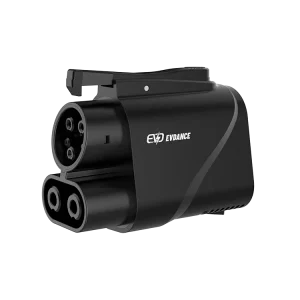
JT08 Adapter: How a NACS-to-CCS1 DC Adapter Works
A NACS-to-CCS1 DC adapter passes DC power and the station–car data conversation through unchanged. Conversion stays in the station; approval stays with the car maker.
A NACS-to-CCS1 DC adapter passes DC power and the station–car data conversation through unchanged. Conversion stays in the station; approval stays with the car maker.
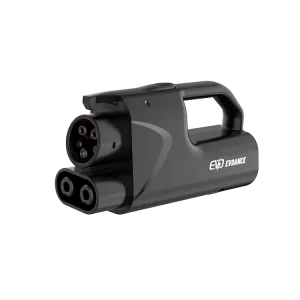
At 250 kW the charger cable is thick and heavy. The JT09’s handle gives grip, alignment and leverage for a fully seated connection — handling only, not more power.
No model list can answer this: a CCS1 inlet, your maker’s adapter approval, an open Supercharger site and a rated adapter must all line up. Check the two documents that decide.
Fit the adapter to the Supercharger’s NACS connector, plug into the car until seated, start by Tesla’s method, and unplug in reverse. The adapter leaves with you.
A 500 A DC adapter rating is a carry ceiling, and 250 kW is that ceiling at about 500 V. The station and your car set the session — here is how to read the numbers.
For an 800 V car the JT08’s stated 1000 V ceiling covers the class, but neither listing publishes a full 200-1000 V window. What is stated, what is not, and the other two gates.
The JT08/JT09 listings describe no lock, thermal sensor or temperature monitoring. DC adapter safety rests on the session’s locking, damage signs, and how fully you seat the connector.
A JT08/JT09 session that fails to start is usually a permission answer — maker approval or site access — before it is hardware. The checks, in order, and when to stop.
A slow Supercharger session through a JT08 or JT09 is almost never the adapter: your car’s charging curve sets the speed. Here is the order to check.
Both the JT08 and JT09 are rated IP66. What that sealing covers in rain and snow — and what it does not — before you plug in at a wet DC stall.