
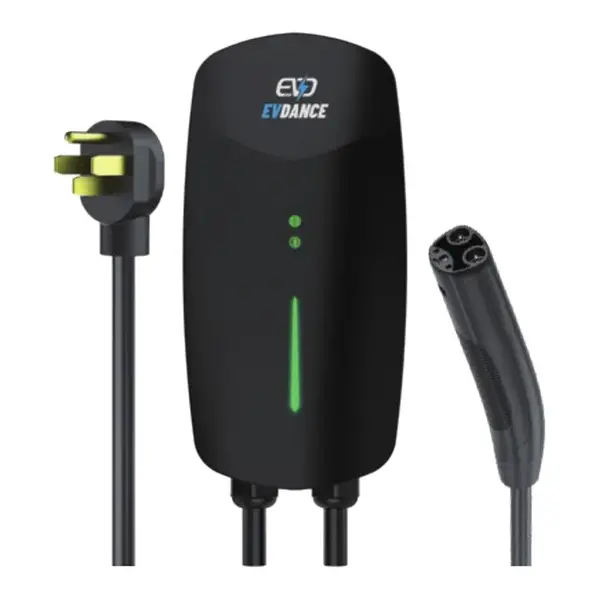
A Level 2 EV charger is an AC charger that runs on a 208–240 V supply and, in homes and small businesses, usually delivers 32 to 48 amps — about 7.7 to 11.5 kW. That is several times faster than a Level 1 cord on a 120 V outlet, enough to refill most cars overnight, and it is the charger type installers fit most often in garages, workplaces and car parks. This guide covers what the ratings mean, how Level 2 chargers are installed, which features matter, and how installers and distributors choose models to stock.
Key Takeaways
- Level 2 = AC charging on 208–240 V. Home units are typically 32 A, 40 A or 48 A (about 7.7, 9.6 and 11.5 kW at 240 V).
- The circuit must be sized at 125% of the charger current: a 40 A charger needs a 50 A circuit, a 48 A charger a 60 A circuit.
- Plug-in units on a NEMA 14-50 outlet top out at 40 A; 48 A and above are hardwired.
- The car’s onboard charger caps the real speed — a bigger charger does not help a car that accepts less.
- For installers and distributors, adjustable current, enclosure rating, cable length and documentation matter more than the headline kW.
What Is a Level 2 EV Charger?
“Level 2” is the North American name for AC charging on a 208–240 V circuit. The charger (more precisely, the EVSE) does not convert power itself: it checks the connection, tells the car how much current it may draw, and switches the supply on and off safely. The car’s onboard charger does the AC-to-DC conversion. In Europe the same idea is called Mode 3 AC charging, and wall-mounted units are usually called wallboxes — see our wallbox EV charger guide.
| Level 1 | Level 2 | DC fast charging | |
|---|---|---|---|
| Supply | 120 V outlet | 208–240 V AC circuit | Three-phase supply to a DC charger |
| Typical power | 1.4–1.9 kW | about 7–12 kW in homes; up to 19.2 kW on an 80 A circuit | 50 kW and up |
| Where it is used | Occasional or emergency charging | Homes, workplaces, hotels, car parks | Highways, fleets, high-turnover sites |
| Who converts AC to DC | The car | The car | The charger |
For a fuller comparison, read Level 1 vs Level 2 vs DC fast charging.
Level 2 Charger Ratings: Amps, kW and Circuits
Level 2 chargers are rated by the current they deliver. Because EV charging is a continuous load, the circuit and breaker must be sized at 125% of that current. This is why home chargers come in steps of 32, 40 and 48 A — each one matches a standard breaker size. Our article on the circuit ladder behind 40 A and 48 A chargers explains the logic in detail.
| Charger current | Power at 240 V | Minimum circuit (125%) | Connection |
|---|---|---|---|
| 32 A | about 7.7 kW | 40 A | Plug-in or hardwired |
| 40 A | about 9.6 kW | 50 A | Plug-in (NEMA 14-50) or hardwired |
| 48 A | about 11.5 kW | 60 A | Hardwired |
On a 208 V commercial supply the same current delivers less power — roughly 13% less than at 240 V. Your electrician confirms the final circuit against the local electrical code; our Level 2 EV charger installation guide walks through the steps.
How Fast Does a Level 2 Charger Charge?
Speed depends on two limits: what the charger can deliver and what the car’s onboard charger can accept. A car with a 7.2 kW onboard charger charges at about 7.2 kW whether it is plugged into a 32 A or a 48 A unit. As a rough guide, 32–48 A adds around 25–45 miles of range per hour of charging, depending on the car’s efficiency. For the arithmetic, see how many kW a Level 2 charger delivers.
Plug-In or Hardwired?
| Plug-in (NEMA 14-50) | Hardwired | |
|---|---|---|
| Maximum charging current | 40 A (on a 50 A circuit) | Up to the charger’s rating, e.g. 48 A or 50 A |
| Installation | Outlet installed by an electrician; charger plugs in | Charger wired directly to the circuit |
| Flexibility | Easy to remove or replace | Fixed |
| Typical buyer | Homeowners, quick upgrades | Garages wanting top speed, commercial sites |
Connectors: J1772 or NACS
In North America, Level 2 chargers come with either an SAE J1772 (Type 1) connector or a NACS connector (standardised as SAE J3400). Many new cars are moving to NACS ports, while a large installed base still uses J1772. Installers and distributors often stock both versions of the same charger, which is why EVDANCE wallboxes are offered as “T” (NACS) and “U” (J1772) variants.
Features That Matter on a Level 2 Charger
- Adjustable current — lets one model fit 40 A, 50 A or 60 A circuits, and older homes with limited panel capacity.
- Enclosure rating — NEMA 4 / IP65–IP66 for outdoor walls and driveways.
- Cable length — 25 ft reaches most parking positions without stretching.
- Connectivity — Wi-Fi or Bluetooth app control for scheduling and usage reports; OCPP for commercial sites that need a charging management platform.
- Load management — useful where two chargers share one supply; see dynamic load balancing.
Homeowners comparing models can use our home EV charger buying checklist and the Level 2 home charger guide.
EVDANCE Level 2 EV Chargers
| Model | Current / power | Connection | Connector | Key details |
|---|---|---|---|---|
| EV-ACT4001T / EV-ACT4001U | 6–40 A adjustable, up to 9.6 kW | NEMA 14-50 plug, 50 A breaker | NACS (T) / J1772 (U) | NEMA 4, IP66; Wi-Fi and Bluetooth; 25 ft cable |
| EV-ACT5002T / EV-ACT5002U | Up to 50 A, 12 kW | Hardwired, 240 V | NACS (T) / J1772 (U) | Type 4 enclosure; Wi-Fi / Bluetooth / optional 4G; 25 ft cable |
| EV-ACT5006T | 48 A / 50 A max, 11.5–12 kW | Hardwired or NEMA 14-50P | NACS | IP65/IP66; 25 ft cable; 3-year standard warranty |
For Installers: Choosing Level 2 Chargers to Fit
Installers want fewer models that cover more jobs. An adjustable-current unit can be set to match the circuit on site, a plug-in version handles quick upgrades, and a hardwired version covers 48 A jobs. A clear manual, a stated enclosure rating and a reliable supply of spare parts reduce callbacks. Our job-site checklist and what an installation quote should include are written for installers.
For Distributors and Brands: Sourcing Level 2 Chargers
Distributors usually stock a small range — a 40 A plug-in and a 48–50 A hardwired unit, each in J1772 and NACS — and add private-label versions as volume grows. Before ordering, ask for the test reports that apply to your market and the exact configuration you will sell. EVDANCE supplies its Level 2 range as stock units or under your brand: samples of 1–9 units, small batches of 100–499 units with a 2–3 week lead time, and full OEM from 500 units. See how to choose an EV charger manufacturer or supplier, our EV charger OEM & ODM service, or all models.
Frequently Asked Questions
Is a Level 2 charger the same as a 240 V charger?
In North America, in practice yes: Level 2 means AC charging on a 208–240 V circuit.
Do I need a dedicated circuit for a Level 2 charger?
Yes. A Level 2 charger needs its own circuit sized at 125% of the charger’s current. See does a Level 2 charger need a dedicated circuit.
Is a 48 A charger always better than 40 A?
Only if the car can accept more than about 9.6 kW and the panel has room for a 60 A circuit. Otherwise a 40 A unit charges the car just as fast.
Can I order Level 2 chargers with my own brand?
Yes. Logo, colour, packaging and connector type can be specified; see the OEM & ODM page for order tiers.

