
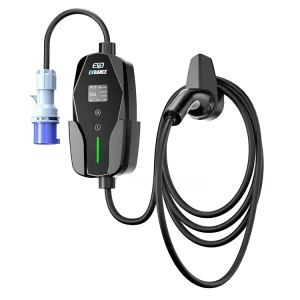
Can a 32 Amp Cable Be Used on a 16 Amp Charger?
Yes — a 32A cable on a 16A charger is the safe direction. The charger sets the session at 16A; the real trap in this pairing is phases, not amps.
Yes — a 32A cable on a 16A charger is the safe direction. The charger sets the session at 16A; the real trap in this pairing is phases, not amps.

No standard hands buyers a maximum Type 2 cable length. Makers build 5 m and 7.5 m leads, 10 m+ is a special case — beyond that, move the charge point.
A coiled EV charging cable is made in a spring shape: it stretches to reach the car, then pulls itself back into a short, tidy helix when you unplug.
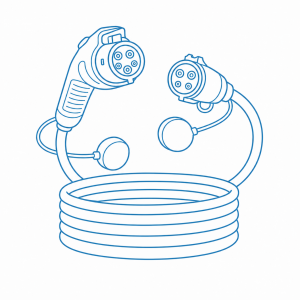
Neither wins outright. Straight cables give you their full length with no pull; coiled cables park themselves neatly but reach less than the number suggests.

A loose charging cable lives in the car, so store it like one: dry before it goes in the bag, both connectors capped, loose loops, out from under heavy cargo.

Yes — rain on the cable itself is normal use. The parts to manage are the two connector ends and any damage to the sheath, not the wet cable run.
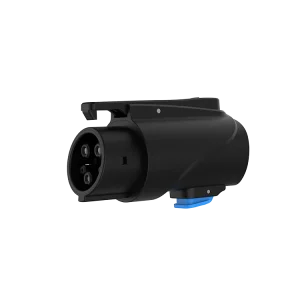
A connector that gets harder to remove over time is usually fighting grit, a worn latch or seal, cold weather, or an adapter’s extra joint. Free the lock first, look, and never force it.

The sharpest difference between OCPP 1.6 and 2.0.1 is security: 1.6 added it through extensions, while 2.0.1 builds charger identity and certificate handling into the core design.
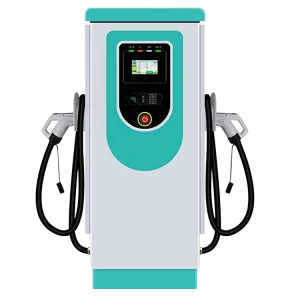
Buy the OCPP version your management platform actually runs. A charger and platform must share a version to talk, so the platform’s current document — not the newer label — decides.
An OCPP certificate is a document, not a badge. It names the holder, the exact product, the OCPP version, and the functions that were tested — read all four before you rely on the claim.