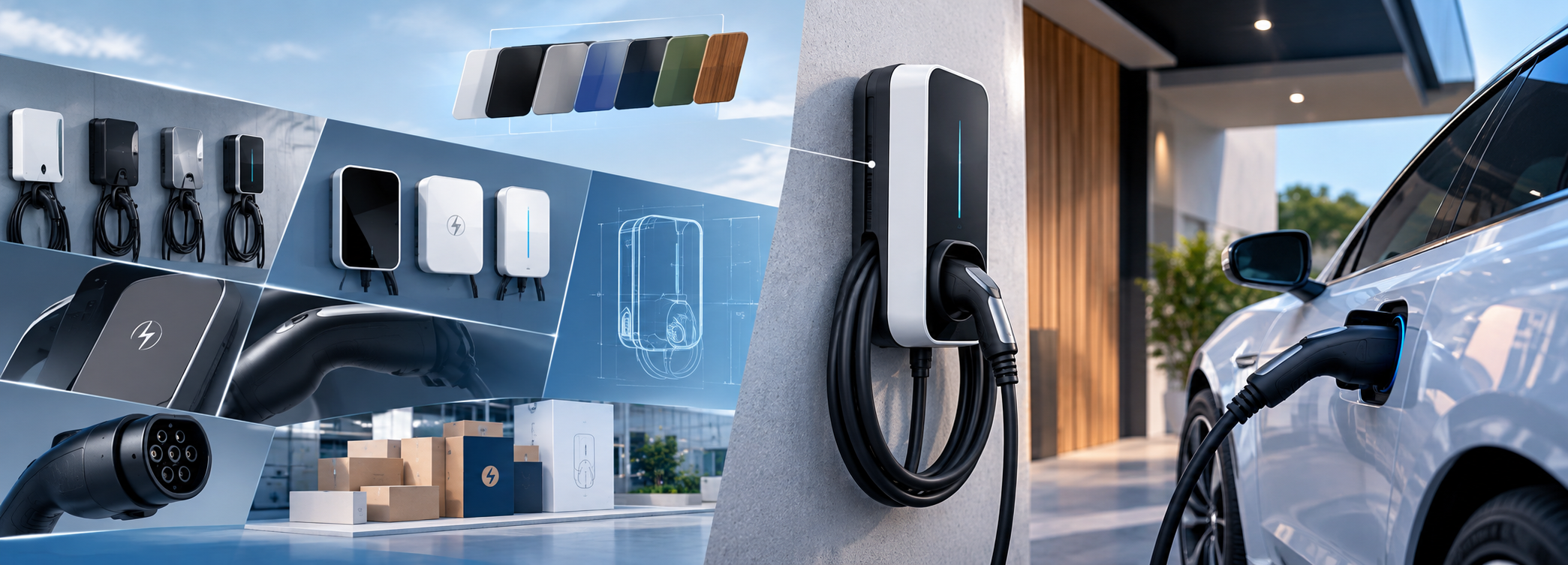
Private-label EV chargers let a brand, distributor, installer or online seller offer chargers under its own name without building a factory or an engineering team. A manufacturer designs and builds the charger, and the brand owner decides the market, the configuration, the look, the price point and how the product is sold and supported.
That model brings real advantages in margin and control, but it also moves responsibility onto the brand. In the EU, for example, a company that puts its own name on a product generally takes on the legal role of manufacturer. This guide walks through each stage of an OEM or private-label EV charger program, links to a detailed article on every topic, and explains how EVDANCE, a Shenzhen charger manufacturer founded in 2011, supports brands through the process.
OEM, ODM and private label: what the terms mean
The three terms overlap, and suppliers use them in slightly different ways, so it helps to agree on definitions before you talk about price or minimums. In practice they describe how much of the design comes from the factory and how much from you.
- OEM (original equipment manufacturing): the factory builds a product to the buyer’s specification, often with the buyer’s own design input or significant changes to an existing model.
- ODM (original design manufacturing): the factory owns a proven design and adapts it for the buyer, usually through branding and configuration choices.
- Private label or white label: the buyer’s brand goes on a product that is largely the factory’s standard design, with the buyer’s logo, colours and packaging.
Most charger brands start with private label on a proven model, then move toward deeper customization as volumes and customer feedback grow. Our article on OEM vs ODM EV chargers compares the routes in detail, and private label vs reselling a branded charger weighs the extra margin and control of your own brand against the extra responsibilities that come with it.
Private label suits several kinds of business. Distributors use it to build a range that competitors cannot simply match on price. Installers use it to offer a charger that carries the same name as their service. Online sellers use it to control listings and reviews, and automotive companies use it to supply chargers that match their vehicle brand. Each starts from the same question: how much of the product do you want to own, and how much responsibility are you ready to take on?
EVDANCE runs both OEM and ODM programs. Engineering, injection molding, assembly and testing are done in-house, the plant runs more than 200 manufacturing equipment units, and products are exported to more than 30 countries. You can read how the program works on our OEM and ODM program page.
Planning the project: steps, MOQ, cost and payment
A private-label charger project follows a predictable sequence: product brief, quotation, samples, artwork and tooling, certification, pilot run, inspection, mass production and shipping. Each step produces something you can check, such as a signed drawing, a test report or an inspection result. How an OEM EV charger project works, step by step explains each stage and the documents you should expect along the way.
Minimum order quantity is usually the first commercial question. MOQs reflect fixed set-up work such as printed packaging, colour batches, cable printing and firmware graphics, spread across enough units to make an order viable. EV charger MOQ explained shows how each layer of customization affects the minimum. EVDANCE offers private label from 50 units, which lets a new brand test a market before committing to large volumes.
Unit cost depends on far more than the electronics. Copper content and cable length, current rating, connector type, enclosure, certification, packaging and freight all play a part, as covered in what drives the unit cost of an OEM EV charger. Agree payment terms early as well: payment terms for OEM EV charger orders compares deposits, T/T transfers and letters of credit, and explains when each makes sense.
Whatever the size of the order, keep a single project file from the first day. It should hold the brief, the quotation, signed artwork, photos of the approved golden sample, certificates, test reports and inspection results. That file supports marketplace listings, customs questions and warranty claims, and it makes each reorder faster and less error-prone.
Configuring and branding your charger
Hardware configuration
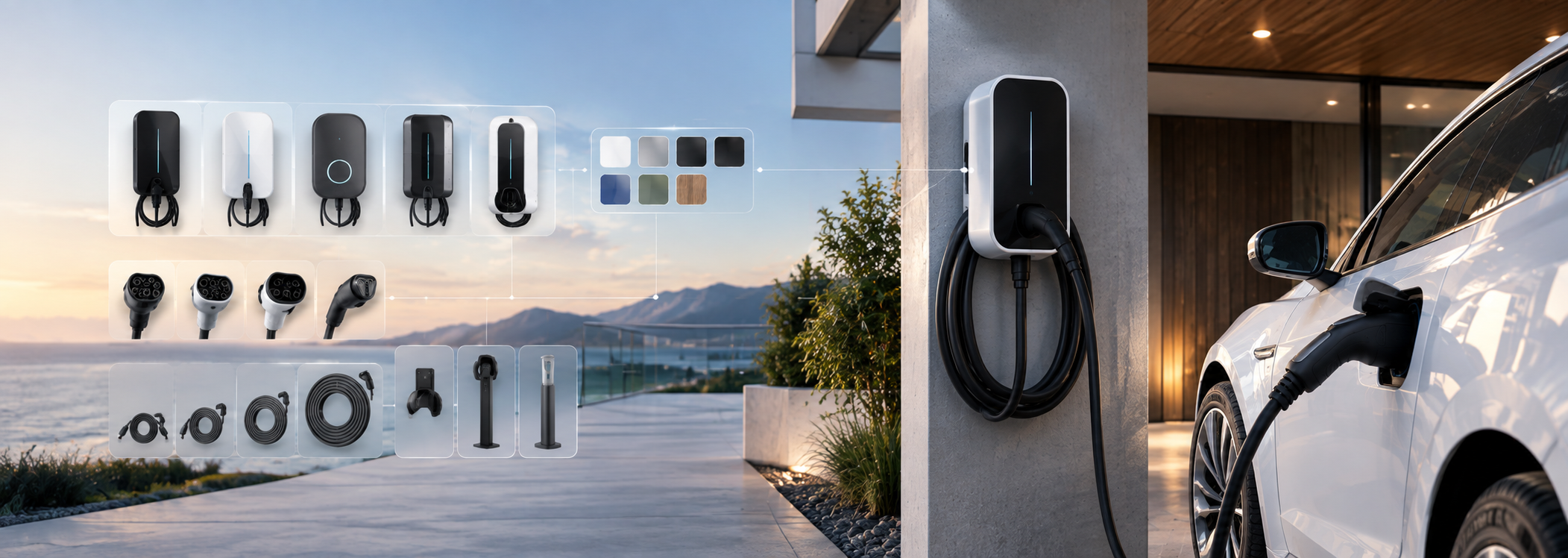
The configuration must match how and where the charger will be used. Start with the vehicle connector: NACS (SAE J3400), J1772 or Type 2, compared in Type 2 vs J1772 vs NACS. Then choose the grid plug and cable length for each market, as explained in choosing plug, cable and connector by market. EVDANCE offers grid plug choices such as NEMA 14-50P, CEE/IEC 60309 and Schuko, and cable lengths of 25 ft or 28 ft for North America and about 5 m or 7.5 m elsewhere.
Enclosure protection matters for chargers used outdoors or left in a garage through the winter; see IP ratings for EV chargers. When you compare base models, it pays to know how to read an EV charger datasheet, and for portable models our portable EV charger buying guide shows the product from your end customer’s side.
Branding, packaging and software
Your logo and colours can go on the housing, cable and packaging. LCD models can carry a custom boot logo and charging graphics, and portable chargers can ship in custom EVA hard-shell storage cases. Logo and branding options for private-label chargers covers the decoration methods and the marks that must stay legible, while packaging, labeling and manuals covers retail boxes, manuals and warning text. For smart-charging models, a white-label app lets customers control the charger through an app in your brand.

Certification and compliance by market
Certification is where private-label projects most often stall. Certification marks vary by model and configuration, so always request the certificate and test report for the exact model and configuration you are buying, and check whether the paperwork needs to cover your brand name. Our overview of EV charger certifications: CE, UKCA, UL, ETL and CB is a good starting point, and the table below points to the detailed guide for each market.
| Market | Main requirements | Detailed guides |
|---|---|---|
| European Union | CE marking (LVD, EMC, RED, RoHS), GPSR, an EU economic operator | CE marking for private-label chargers; GPSR and the responsible person |
| Great Britain | UKCA or CE marking, importer duties | UKCA vs CE in Great Britain |
| United States | NRTL safety listing, FCC authorization, optional ENERGY STAR | UL and ETL listing; FCC rules for EV chargers; ENERGY STAR for EV chargers |
| All markets | Correct rating labels and markings, certificates that match your brand | rating labels and required markings; who owns the certificate |
In the EU, the manufacturer is responsible for carrying out the conformity assessment, compiling the technical documentation and drawing up the EU declaration of conformity before the CE marking is applied. A brand that sells under its own name is treated as that manufacturer, so it needs access to those documents. Since 13 December 2024, the General Product Safety Regulation has also required products to carry information on an economic operator located in the EU.
In the United States, chargers are normally safety listed by a Nationally Recognized Testing Laboratory, and each NRTL uses its own registered certification mark. Electronic devices, including smart chargers with Wi-Fi or Bluetooth, must also be authorized under FCC equipment rules before they are marketed or imported.
These rules change over time and differ in detail between markets. Treat this guide as orientation rather than legal advice, and confirm your obligations with a test lab, notified body, customs broker or lawyer.
Protecting your brand, IP and legal position
Your brand name is the asset you are building, so protect it before you print it on 50 or 5,000 chargers. In the US, federal trademark registration creates nationwide rights and can be recorded with U.S. Customs and Border Protection to help stop infringing imports. Register your trademark before ordering private-label chargers covers the US, the EU, the Madrid System and China, where trademarks are registered on a first-to-file basis.
Before you share drawings or a new feature idea, sign a confidentiality agreement and agree in writing who owns any custom tooling, as explained in NDAs, NNN agreements and tooling ownership. A registered or pending trademark is also the entry ticket to Amazon Brand Registry for EV charger sellers, which gives brand owners more control over their product listings.
Owning a brand also means owning more of the liability. The new EU Product Liability Directive applies to products placed on the market from 9 December 2026 and treats a company that presents itself as the manufacturer by putting its name on a product as a manufacturer. In the US, manufacturers, importers, distributors and retailers have a duty to report certain hazards to the CPSC. Product liability for private-label EV charger brands explains what this means and how to prepare.
Choosing a supplier and controlling quality
A capable supplier is the foundation of everything above. Look for in-house engineering and testing, documented processes, real certificates you can verify, and a clear point of contact. Our guide on how to choose a portable EV charger supplier lists the questions to ask, and the EV charger factory audit checklist helps you verify the answers on site or through a third-party auditor.
Quality control works best as a series of checkpoints rather than a single test at the end:
- Sample stage: test a standard sample, then approve a branded golden sample, as described in how to test an EV charger sample before a bulk order.
- Production stage: ask for end-of-line test records, including dielectric strength (hi-pot) and functional charging tests.
- Before shipment: book an independent inspection using the approach in pre-shipment inspection and AQL sampling.
- After launch: record returns by failure type and share the data with the factory so causes can be fixed at source.
Every EVDANCE project has a dedicated account engineer from sampling through to mass production, so questions about configuration, test results or labels go to one person who knows your order.
Importing, selling and after-sales support
How goods move affects cost, risk and paperwork. FOB vs DDP compares the two shipping terms EVDANCE offers: under FOB you control the main freight and customs clearance, while under DDP goods arrive with duties paid. US importers should also read importing EV chargers into the US for the basics of customs entry, HTS classification, Importer Security Filing and Section 301, and confirm classification and duties with a licensed customs broker.
Selling well depends on a coherent range and dependable support. How distributors build a profitable EV charger product line covers range planning across portable, wall-mounted and commercial chargers, and selling portable EV chargers online covers marketplace listings, documentation and returns. If you sell to workplaces or charge point operators, OCPP explained shows how chargers connect to management platforms.
Launch planning deserves the same care as production. Prepare product photos and listing text that match the certified configuration, train your support team on installation questions, and keep a small stock of spare cables and connectors for early warranty cases. Customers rarely complain about a charger that works; they complain about slow answers when something goes wrong.
Finally, agree warranty and after-sales terms before the first order rather than after the first failure. EVDANCE provides a 3-year standard warranty, and warranty and after-sales terms for distributors lists what to put in writing, from spare parts to failure analysis and replacement rules. Distributors and resellers can find program details on our resellers and distributors page.
Key Takeaways
- Private label lets you sell chargers under your own brand, but you take on manufacturer-level responsibilities in markets such as the EU.
- Plan the project as a sequence of documented steps, and agree MOQ, cost drivers and payment terms before samples are made.
- Request certificates and test reports for the exact model and configuration, and check that they work for your brand in each market.
- Protect your trademark early, control quality at several checkpoints, and agree warranty terms before the first order.
Sources & Standards
- European Commission (DG GROW) — Manufacturers – CE marking
- European Commission — General Product Safety Regulation factsheet
- Federal Communications Commission — Equipment Authorization
- U.S. Occupational Safety and Health Administration (OSHA) — Nationally Recognized Testing Laboratory Program
- U.S. Patent and Trademark Office — Why register your trademark?